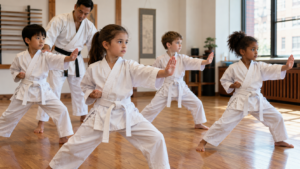

Karate helps children develop balance and coordination by teaching them to control posture, shift their weight, combine upper- and lower-body movements, and respond to instructions while moving. These skills develop through structured repetition rather than a single exercise. At Harmony by Karate, we help students build body awareness gradually so they can move with greater control, confidence, and safety inside and outside the dojo.
Balance and Coordination Support Everyday Movement
Children rely on balance and coordination throughout the day. They use these skills when climbing stairs, riding a bicycle, catching a ball, navigating a crowded classroom, or recovering after an unexpected change in direction.
Balance helps a child maintain control while standing still or moving. Coordination allows different parts of the body to work together in the correct order. Although these abilities are closely connected, each one requires practice.
Karate gives children regular opportunities to strengthen both skills through stances, footwork, blocks, kicks, turns, and forms. Every movement asks the student to pay attention to where their body is and what it needs to do next.
Body Awareness Helps Children Move With Control
Body awareness is the ability to recognize where different parts of the body are positioned and how they are moving. It involves proprioception, which provides information from the muscles and joints, along with visual and vestibular input related to sight, movement, and balance.
A child uses body awareness when stepping over an obstacle, reaching for an object, or turning without colliding with someone nearby. In karate, students practice this awareness intentionally.
An instructor may ask a student to check the distance between their feet, the bend in their knees, the direction of their hips, or the position of their hands. These specific corrections help children connect verbal instructions with physical movement.
This combination of listening, observing, remembering, and adjusting also supports the executive function skills children use to complete multi-step tasks.
Stable Stances Create a Foundation for Movement
Karate stances teach children how to position their feet, distribute their weight, align their posture, and maintain a stable base. A stance may appear simple, but holding it correctly requires several parts of the body to work together.
Students need to keep their feet in the correct position while controlling their knees, hips, shoulders, and upper body. They must also remain attentive enough to notice when their posture changes.
Beginners usually practice basic positions slowly. Once a student can maintain a stable stance, the instructor can introduce steps, turns, blocks, and other movements. This progression gives children a reliable physical foundation before the activity becomes more complex.
Weight Shifting Develops Dynamic Balance
Standing balance and moving balance present different challenges. Dynamic balance is the ability to remain controlled while the body is changing position.
A child may shift their weight onto one leg before performing a controlled kick. Another exercise may require stepping forward, turning, changing direction, and returning to a stable stance. Each transition changes the child’s center of gravity.
Karate teaches students to recognize these changes and adjust their posture accordingly. They learn to place the supporting foot carefully, control the speed of the movement, and return to a balanced position instead of rushing through the technique.
Safe progression matters. Movements should match the student’s age, experience, mobility, and current level of control. We introduce new challenges gradually and provide corrections that students can understand and apply.
Karate Coordinates the Arms, Legs, and Core
Many karate techniques require the upper and lower body to perform different actions at the same time. A student may step into a stance while moving one arm into a blocking position and keeping the other hand properly chambered.
At first, a child may remember the footwork but forget the hand movement. Another student may perform both movements but struggle with their timing. These are normal parts of learning coordination.
We break techniques into smaller components when needed. Students can practice the footwork, hand position, direction, and timing separately before combining them. Repetition allows the movements to become smoother and more organized.
This process also teaches children how to approach a complicated task. They learn to focus on one part, practice it carefully, and add the next step when they are ready.
Forms Strengthen Sequencing and Directional Awareness
A karate form, or kata, is a planned sequence of stances, techniques, turns, and changes in direction. Forms require students to remember what comes next while maintaining balance and control.
Students must distinguish left from right, track their position in the training area, and coordinate their movements in the correct order. They also need to recover when they lose their place.
These exercises connect physical coordination with working memory and sustained attention. Our article about how karate develops focus through purposeful movement explains why involving the body can help students stay engaged with a task.
Group Training Builds Spatial Awareness
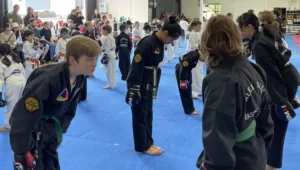
Children do not practice in isolation. They share the dojo with classmates who are also stepping, turning, and practicing techniques.
Students learn to remain within their training space, maintain a safe distance, and notice the movement happening around them. They must listen for signals, move in the correct direction, and stop with control.
These habits can support everyday spatial awareness in classrooms, playgrounds, sidewalks, and other shared environments. For children living in Manhattan NYC, learning to move attentively around other people has practical value.
Personal Progress Reduces Unnecessary Comparison
Some children enjoy competitive team sports. Others feel more comfortable in an activity where progress can be measured against their previous ability.
Karate allows a child to work on holding a stance more steadily, turning with better control, completing a sequence with fewer prompts, or improving the timing between their hands and feet. These are observable signs of progress.
A student can recognize improvement without needing to score more points than another child. This creates room for children with different physical abilities, learning styles, and levels of experience to develop at an appropriate pace.
Our approach to supporting special needs students in karate includes predictable routines, clear demonstrations, repetition, and respectful adjustments when a child needs a different learning approach.
What Parents Should Look for in a Children’s Karate Class
A well-structured children’s class should include clear demonstrations, age-appropriate movements, adequate supervision, and constructive feedback. Instructors should explain what students are practicing and give them enough time to repeat a movement before adding more complexity.
Parents can also consider how the instructor responds when a child struggles. Effective instruction corrects the movement without embarrassing the student. It gives the child a specific adjustment to make and another opportunity to try.
Class structure and group size also affect the experience. Younger beginners often benefit from short instructions, visible demonstrations, predictable transitions, and individual feedback.
Harmony by Karate offers private and group karate classes, allowing families to explore the learning environment that best fits the student’s needs.
Balance and Coordination Develop Through Consistency
Every child develops physical skills at a different rate. Age, growth, previous activity, confidence, attention, and attendance can all influence progress.
Karate provides a consistent setting where children can practice stable posture, controlled weight shifts, directional changes, coordinated techniques, and movement sequences. Over time, these experiences can help students become more aware of their bodies and more comfortable learning unfamiliar physical tasks.
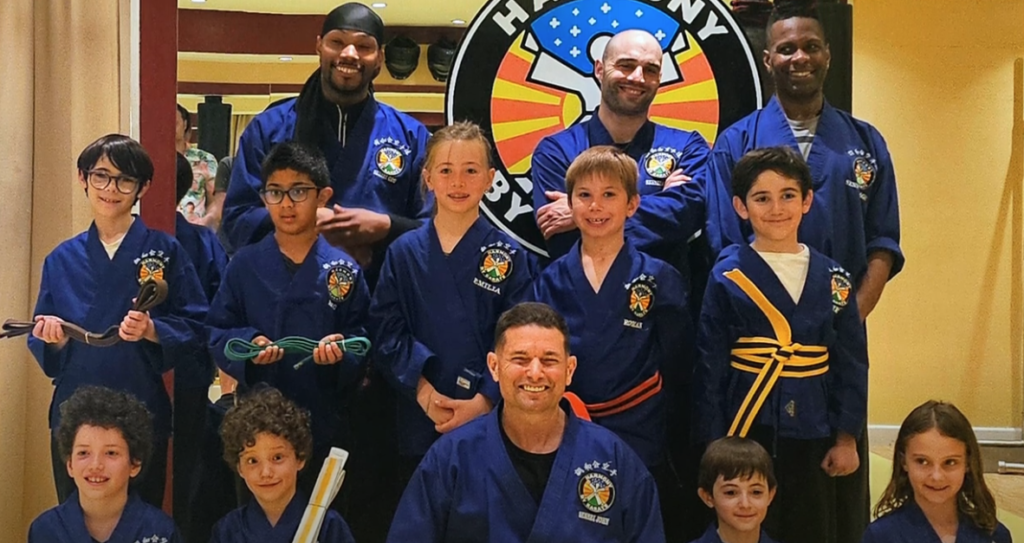
At Harmony by Karate, we teach children to move with purpose while developing focus, confidence, patience, and self-control. Families interested in karate on Manhattan’s Upper West Side can visit our Contact page to pre-enroll or ask us any questions.